 |
| Center for Global Development |
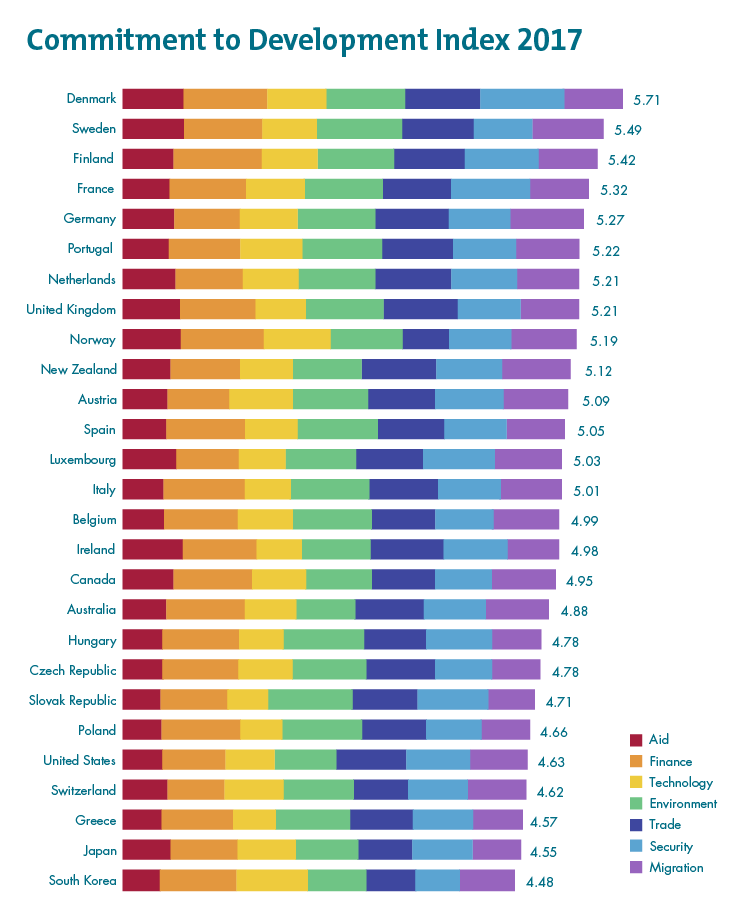
“With great power comes great responsibility”. As we are seen as the leading world power, we need to show we can take that power and put it forward to helping others. However, the US seriously lacks in funding Humanitarian work, hindering its ability to use its power for the benefit of our planet and the human species. Gaby Galvin from US News, a media source that has specialised in finance of everyday and international issues for over 80 years, writes on how the United States compares to the other world powers in terms of Humanitarian aid in developing countries. By using the Commitment to Development Index, which is “an annual ranking of 27 of the wealthiest nations in the world by how well their policies help people in developing countries” that takes into account 7 variables “aid, finance, technology, trade, environment, security and migration” and adjusts each country's final score according to its GDP. And out of the 27 world powers, the US is ranked 24th in aid. The US needs to use its huge influence to create incentives for other countries to aid the less fortunate, because without compassion, we will continue down the path of being viewed as the enemy of development and opportunity.
The US does donate a lot of money to humanitarian work, but not nearly as much as it could. The US donates only “0.18 percent of its national income to aid, above just five other indexed countries”, to put in perspective, the leading country on the Commitment to Development Index, Denmark, “gives 0.75 percent of its national income to aid efforts, according to the report, one of the few countries to meet the 0.7 percent target the United Nations first adopted in 1970”. After 47 years of having this goal in front of them, the US has not staggered much, in fact, our aid will now decrease since “U.S. President Donald Trump signed an executive order banning Washington from helping pay women in developing countries for birth control, abortion and family planning education” and in a blaze of humanitarian glory, “The Netherlands quickly announced the creation of an international fund to help offset the withdrawal of U.S. funding”. As the world’s leading power, we should not be in 24th place for humanitarian work, let alone taking away aid then letting competing countries outshow us by picking up our slack.
But how does the US improve? Is it even possible? Germany in the last year improved its rank by “10 slots in this year's index, ranking fifth overall”. Germany achieved this goal by accepting thousands of refugees seeking asylum from war and famine infested countries. How has Germany improved its rank so well by immigration when the US, the land of opportunity, the mixing pot of cultures and was built on the backs of immigrants, still remains at the rock bottom? Due to immigration reform and cuts in foreign aid, the US may be expected to drop even further down the list in the coming years. If we want to stay a world power, we need to show we belong there by being at the top of the list with the best, not clinging onto the bottom for dear life.
One may ask where the US gets the money for funding foreign aid, after all, we are in debt. The US is involved in some very shady overseas military deals where “it sells arms to poor and undemocratic countries, [and, in turn] it doesn't sign up for a lot of international agreements relative to its peers”. Instead of giving advanced (highly expensive) weapons to a bunch of rogue militants, the US should be funding research for medical research, health services access and drug supplies for those who can’t afford it. Instead the US is “outranked by Central European nations Hungary, Slovakia, Poland and the Czech Republic, where the average income per person is less than half of that in the U.S”. If the US stops being selfish and shares its wealth with the world and benefits the human race, the entire world, including itself, would be better off for it. Ian Mitchell, an economic and developmental policies expert for the Center of Global Development in Europe, says it best, “with prosperity comes peace, comes collaboration, comes the mutual exchange of ideas and a better economic growth for everyone. So if we can develop the entire world, it will reflect back on us and our own security and prosperity”. By sharing our prosperity, we not only create peace, global relationships that aid in trade and technological advances as the world’s most advanced countries work together to solve problems, but it reflects back on us positively, showing that by sharing our wealth, we are wealthy, generous and confident in the change we can accomplish, and will finally be a world power that enacts change.


